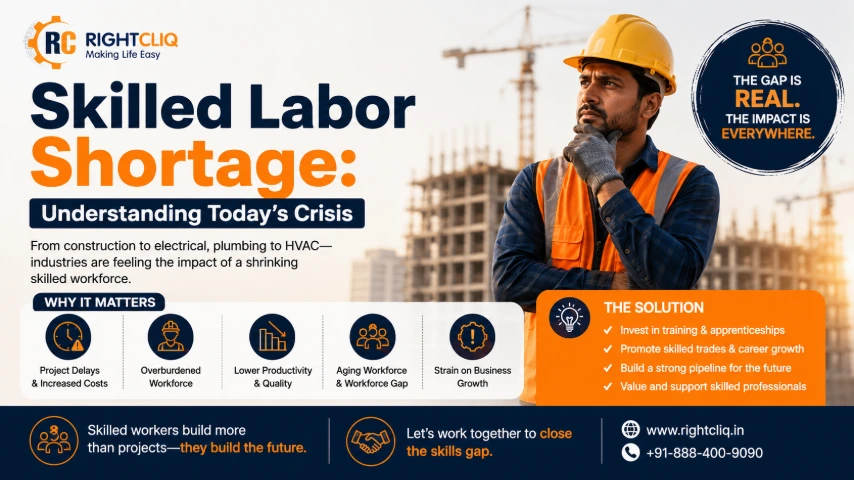
Skilled Labor Shortage: Understanding Today’s Crisis

What Is the Skilled Labor Shortage and Why Is It Happening?
The skilled labor shortage is now at such a level of crisis that the sector is losing $10.8 billion a year. Some 500, 000 workers are absent from the labor force. A staggering 91% of construction companies have difficulty in recruiting staff. The two thirds have experienced project delays due to labor shortages. Because of this skilled labor shortage, approximately 19,000 fewer SFHs have been completed in 2024. How and why was the labor pipeline poisoned? In this enthusiastic guide, we examine the main reasons here. In addition, the report looks at the financial consequences for home services and contractors. Furthermore, it presents effective tactics for luring skilled workers to the trades and vocational career options.
The Scope of the Skilled Labor Shortage in India
The shortage of skilled labor is not limited to one market. It's a worldwide problem with construction and manufacturing industries, and many companies are unable to find qualified workers to fill job vacancies. There is great disparity, according to most reports, between the increased demand for skilled tradespeople, and the supply of these workers.
It's that broader trend that's significant in the context of India as well. The elements of the issue are all too well known: skill shortages, less trained workers available for trade occupations, high demand for skilled workers, and the urgent need to attract new talent. To see just how severe the skilled labor shortage is, it is necessary to first take a look at the sector itself and then examine some recent data on the skilled labor shortage.
Overview of India’s Home and Construction Services Sector
House and building repair, maintenance and completion services are reliant on trades such as electricians, carpenters, installers, as well as supervisors and inspectors, who are all skilled persons. When jobs are unfilled, commerce comes to a halt. Related industries, amongst which construction and manufacturing, are particularly impacted as these sectors are dependent on technical skills and stable workforce.
Construction firms have a need for skilled workers at all levels to ensure they meet deadlines and maintain quality. A lack of steady continuous development means workforce shortages result in delays, higher rates of pay, and decreased capacity, all of which are increasing the gap.
The latest trends reflecting the skilled workforce gap are as follows
The skills shortage is not to be missed during recent years. Leading manufacturing firms report that a scarcity of qualified construction workers continues to cause problems for construction companies. Since the demand of labor is greater than the supply, there are many positions which are not being filled. This gap is usually reflected in labor shortage indexes and the sorts of things that track it, which compare jobs available, difficulty finding workers, exit mechanisms such as retirement, and available workers. Employers reporting a shortage of construction workers is evident when looking across regions and industries at the open jobs currently unfilled data.
Trend Area | What It Shows |
Job openings | Rising demand for skilled workers in construction and manufacturing |
Employer feedback | Many firms report difficulty finding qualified workers due to the existing workforce aging out. |
Workforce age | More experienced workers are nearing retirement |
Talent pipeline | Fewer young people are entering skilled trades |
Recent years | The gap has widened as demand keeps increasing |
Core Factors Behind the Skilled Labor Shortage
There is a lack of skilled trade workers for several reasons. The obvious retirement, reduced talent pipeline, and the lack of enough younger workers entering the profession are the largest. When skilled people die or retire, companies lose not only skilled people, but skilled expertise also.
Meanwhile, training programs are not squarely in line with demand. There is a push for many young people to go on the traditional academic path rather than a trade path. This means that the next generation is less attached to ‘dirty’ jobs. Understanding the two big forces shaping the shortage is the first step to fixing it.
Experiencing demographic changing and a growing older workforce
Demographic changes are a big reason behind the labor shortage. In construction and manufacturing, many of those who currently work are approaching retirement age with years of experience and expertise under their belts. Unfittingly few young people are pursuing these careers, and the new workforce is nowhere near enough to replace those leaving, creating a labor shortage in these fields.
For employers this translates to undrafted slots and fewer mentors to new staff, less in-house knowledge, and increased strain on the remaining workforce. An aging workforce is one of the main reasons why the shortage has continued to escalate in the fields of home and construction services.
Impact of Labor Shortages on Construction and Home Services
The labor shortage is having an impact on construction work daily. It takes longer for an organization to hire staff and the recruitment process is getting more costly and competitive. The wider the skills gap, the more difficult it is to do routine scheduling.
You can see the impact in missed deadlines, increased workloads and increased operational costs. New projects are subjected to delay, or possibly project is rejected because company lacks qualified workers. The following two sections illustrate the impact this "labor shortage" has on project delivery, and job site performance.
The increase in the time for a project and the subsequent increase in the project costs
The visible effect of the shortage is when projects are delayed. If the required numbers of open jobs are not filled, crews are unable to meet schedules on assignments. That delays deadlines and foster frustration on both sides – client and contractor.
Meanwhile, increasing costs are difficult to avoid. To secure adequate labor, companies frequently will increase pay rates, provide incentives, and/or pay overtime. All these measures can provide temporary relief, but also reduce operations profit and erode the margin.
This is the impact that the shortage has on the economy in general. Slower projects can affect productivity, curtail business development and slow down investment projects. Firms when they have to under-staff may turn away work. That slows down growth in building and other residential services over the long haul.
Quality problems and higher safety risks exist
Having fewer workers may also bring quality challenges though. Facing a shortage of qualified skilled trades in the manufacturing sector, companies can end up hiring inexperienced workers or putting existing personnel on overload. For precision jobs involving a lot of manual work, that can impact workmanship.
Risk of injury increases as well. Fatigued workers are prone to inaccurate work and inexperienced workers may not have established work habits like more experienced workers. That can cause significant operational and financial risks in construction.
Typical insurance hazards associated with a labor shortage are:
More accidents at work due to fatigue or inexperience
Increased risk of re-doing due to quality concerns
Delays and default on deadlines
Risk of greater liability when safety procedures not followed consistently
Different ways to address the skilled labor shortage
Hiring alone isn't the solution to the shortage. What they require is workforce development, which takes time to grow their skills, rather than short-term, stopgap solutions to fill an urgent need. The greatest response is a combination of recruiting, training and retention efforts.
Practical approach to providing apprenticeships, school partnerships, and improved marketing for trade careers are available options. Companies should also have a clear career trajectory which will enable workers to see the merit in joining the industry. The following sections provide some details on two strategies that can help employers attract and build a deeper pool of future potential.

Increasing Apprenticeship and Workforce Development Programs
One of the best responses is growing the number of apprenticeship programs. These sorts of events provide new staff with a possibility to learn via real work, and also move the technical skills as a structured learning route. That helps to hire them or have them join their business.
Collaborating with businesses with schools, local training providers and community groups is most effective also in workforce development. This provides a more secure pathway into their employment roles, and enables employers to design training for true workplace needs.
Practical steps include:
Designing apprenticeship programs that incorporate class work and work-based learning experiences, as well as offering flexible work schedules.
Collaborating with high schools, CTE programs and trade schools
Providing incentives for the new employees with certifications and on the job training
These are efforts to combat human capital shortage by transforming human capital candidates into human capital in the form of qualified workforce.
Bringing Careers in Skilled Trades to the Younger Generation
Attitudes among youth towards skilled trade jobs are critical. Students still think that their only options are traditional college routes and haven't considered stable, well-rewarding trade careers. One way for a business to work against it is to interact with students at an earlier age, whether through career fairs, school visits, internships and/or open houses, particularly in high schools where career decisions start. It is important for employers to talk up progression routes within the trade jobs too.
If students and parents see opportunities for development and career that pays well more will be considering this career choice. Better workforce for the future through effective outreach.
What It All Means
Overall, the shortage of skilled labor in home and construction services is a significant challenge that needs to be addressed. It is important to grasp the underlying drivers of this problem: demographic changes, vocational education drop-off and its effect on project timelines and costs. Increasing the number of apprenticeships and encouraging young people to pursue careers in the skilled trades could address this skills gap. The construction industry's frontline is the industry's ability to address these challenges, which will lead to greater health, quality and efficiency of services. It's time to put a focus on the next generation of skilled workers for a sustainable future.